
Mathematics Ph.D. candidate in Victoria B.C. who enjoys music composition.
For mathematics, read on below. For my music, go to the music page or bandcamp. For tools and books I’ve made, go to the composition tools and books pages.
math research
I am broadly interested in combinatorics. My current projects and areas of interest largely fall within combinatorics and graph theory, and sometimes involve algebraic perspectives.
combinatorics: classification problems on configurations of points involving specified or forbidden structure on the relations between points; families of arithmetic progressions; combinatorial objects representing musical structures.
algebraic combinatorics: algebraic methods in combinatorics; matrix decomposition problems;
graph theory: boxicity; covering problems; structural graph theory; spectral methods.
Combinatorial decompositions (Ph.D. work in progress, defending ~Apr 2027)
My dissertation research broadly relates to decompositions. I will elaborate on details at a later date, but below is a general idea.
The first type of problem I study is of the following form: A parameter of interest p can be found by analyzing integer solutions to a large underdetermined linear system, and the problem is that this system is too underdetermined (say, n! variables and n^2 equations); the solution is that sometimes p can be found by other means much more efficiently.
The second type of problem: Fix m. Given an integer linear combination of m permuted copies of an object (polynomial, or matrix) A that equals a symmetric object, what constraints must hold on the integer coefficients? This perspective of fixing m apriori appears to be a novel perspective, and I provide several results and techniques apropos to this perspective.
boxicity
The boxicity of a graph G is the smallest dimension d such that G can be represented as the intersection graph of axis-parallel boxes in d dimensions. Calculating boxicity is an NP-hard problem for general graphs. Here is an example of a graph G with boxicity 2 and an associated family of boxes.

Few graphs classes with unbounded boxicity are known to have polynomial-time computable boxicity. The complements of block graphs have unbounded boxicity. In the work below, with Marco Caoduro and Will Evans, we design a polynomial-time algorithm to compute the boxicity of complements of block graphs. Our method also yields the analogous result for the threshold dimension (a similar parameter to boxicity involving threshold graphs). Our work suggests a general method that may yield efficient solutions to similar problems for other block-restricted classes.
(on arXiv Oct 2025): A polynomial algorithm to compute the boxicity and threshold dimension of complements of block graphs
The underlying goal that interests me in the area of boxicity is to broaden the list of classes of graphs that permit polynomial-time boxicity computation.
(Update): We have successfully generalized our method used above for block graphs to show that any poly-time computation of co-boxicity on a family of 2-connected graphs F, with possibly pendants attached, can be extended to a poly-time computation of co-boxicity of a graph whose blocks are in F. We have submitted to WALCOM 2027. Updated version of paper to come soon.
families of arithmetic progressions
An arithmetic progression of size k with common difference g has an interval of distance multiplicities, where gi occurs with multiplicity k-i. Reducing modulo n, a large subclass of modular arithmetic progressions satisfies the same distance multiplicity property (sometimes called “Erdős-deep” (ED)). For example: {0,3,6,9} modulo 13. These sets may be interpreted as musical rhythms with a timespan of n pulses and k onsets (note hits) and n-k rests. The distinct gaps between onsets each occur a distinct number of times, and so ED rhythms can be used to create compelling percussive structures with emergent patterns. Since music often involves overlapping rhythms, a natural goal is to construct and classify families of ED rhythms that preserve the same rich structure on the onset gaps collectively. That is, the union of internal distances of the constituent rhythms produces an interval of multiplicities.
Here is some music that I wrote using ED rhythm families to organize the percussion parts:
In 1982, Paul Erdős posed the following planar geometry conjecture: for all k sufficiently large, there does not exist a configuration of k points in the plane such that the distances form an interval of multiplicities (assuming no 3 points in a line and no 4 points in a circle). There are known examples for k at most 8, but no proof is yet known. Below is an example configuration when k = 5, where distance values are distinguished by colour.
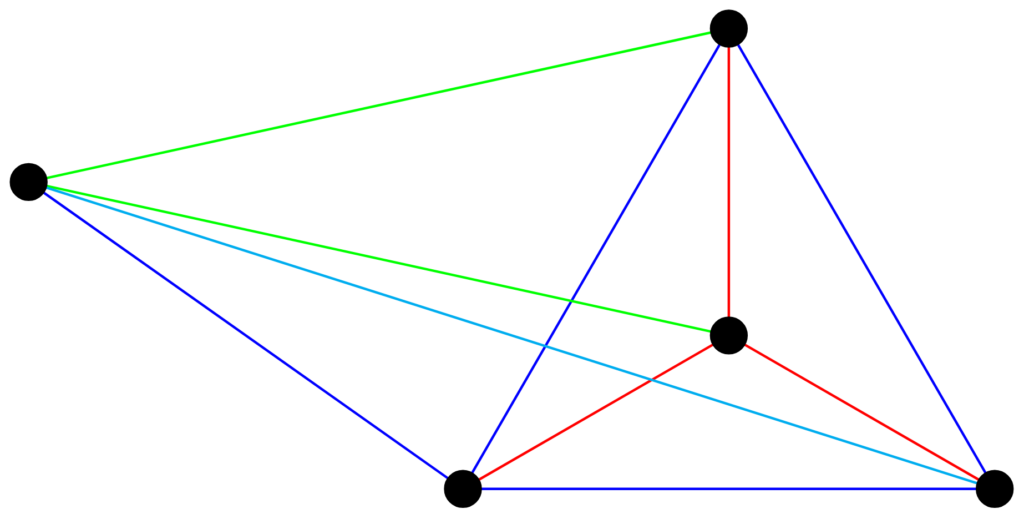
Similar questions can be asked in other finite metric spaces like in the set of integers modulo n with respect to the minimum difference metric. Inspired by this geometric problem and motivated by the application to musical rhythms, the following work, in collaboration with Peter Dukes, completely classifies the pairs of these modular arithmetic progressions, and also proves a general construction for larger families.
(on arXiv Aug 2022): Families of modular arithmetic progressions with an interval of distance multiplicities
(MR4573622; published in Integers Mar 2023)
I am broadly interested in similar AP family classification problems (and constructions), especially in the case where *both* the multiplicities and distances form an interval (this condition is sometimes referred to as “Winograd”).